
Technology Ownership & Deployment
Progressive Cutover Migration: How to Move Financial Platforms Without an All-at-Once Cutover
Replacing core financial-services software affects far more than the visible customer interface. Progressive Cutover Migration provides a staged alternative that can move selected users, data and integrations in controlled phases while the wider transition is validated.
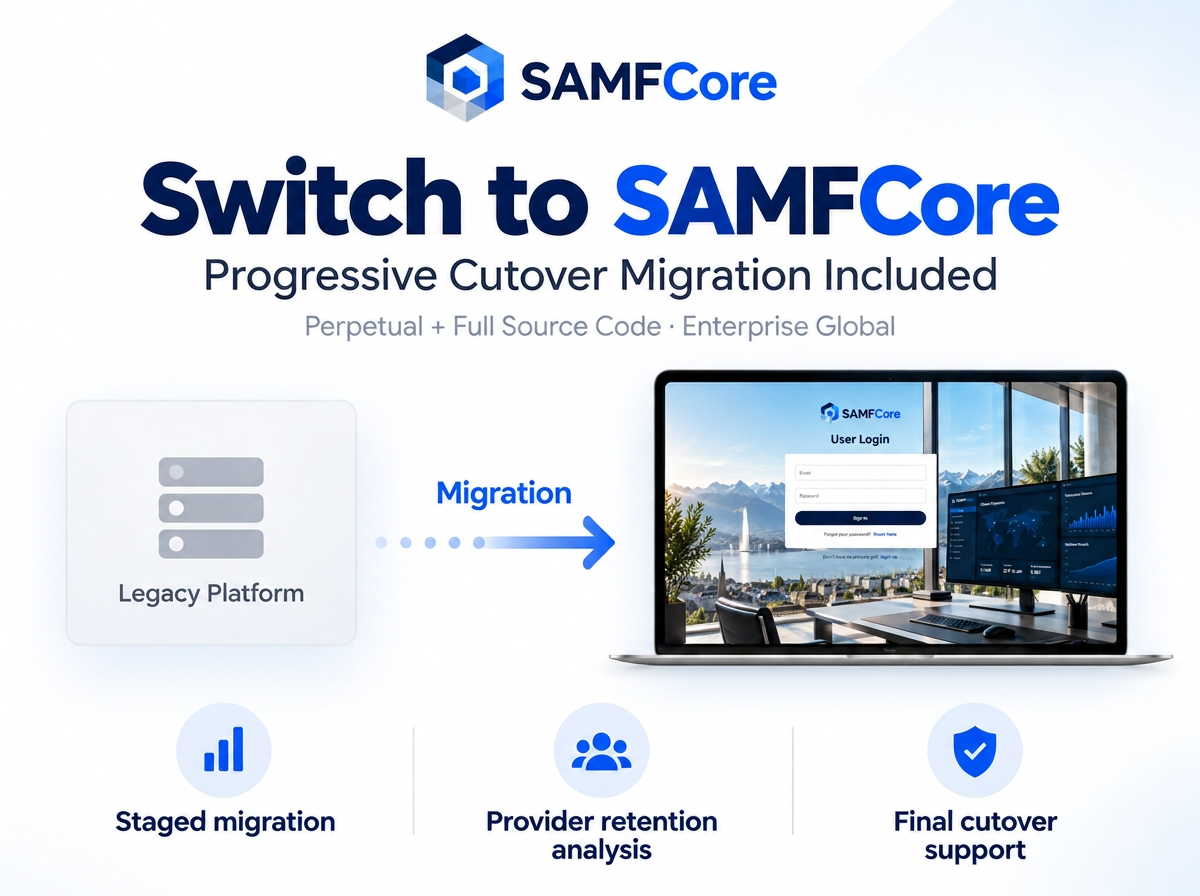
Replacing core financial-services software is not simply a matter of moving a database and switching on a new interface. A financial platform migration can affect personal and corporate customer records, balances, account data, transaction history, authentication, provider integrations, payments, cards, KYC and KYB records, AML and compliance workflows, and the administrative tools staff use every day.
A traditional big-bang migration moves the agreed scope during one major cutover event. That can shorten the period in which two environments operate, but it also concentrates implementation, data, integration and operational risk into a narrow window. Progressive Cutover Migration offers a staged alternative: configure and validate the new environment, move selected users or customer groups in controlled batches, and complete final cutover after the agreed checks have been satisfied.
The right approach depends on the source platform, available data access, authentication model, provider stack and technical architecture. Progressive migration is not a universal replacement for direct cutover. It is a migration design option for projects where staged transition and parallel operation are technically feasible.
What Is Progressive Cutover Migration?
Progressive Cutover Migration is a phased migration model in which the existing platform may remain operational while selected users or customer groups transition to SAMFCore. The new licensed deployment can be configured, integrated and validated before the entire customer population moves. Users who have not yet migrated can remain on the legacy platform where the source system and surrounding architecture permit that arrangement.
The process creates defined checkpoints rather than treating migration as one irreversible event. Data and integrations are prepared according to the agreed architecture; an initial group is moved; results are reviewed; and later groups follow when the relevant operational, reconciliation and support checks are complete. Final cutover happens after the new environment has been validated and the remaining users are ready to migrate.
Feasibility always depends on the source platform and technical architecture. Some legacy systems support clean exports, APIs and segmented routing. Others restrict data access, authentication portability or parallel operation. These constraints need to be established during assessment rather than assumed.
Progressive Cutover Migration vs a Big-Bang Migration
A big-bang migration moves the agreed users, data and operational processes during one main cutover. It can offer a shorter period of parallel operation and may suit a smaller or less complex deployment, but operational risk is concentrated around that event. Teams must validate data, integrations, access and procedures within a tightly controlled window.
A progressive cutover spreads transition across controlled batches. The project can validate each stage before scaling, isolate issues to a smaller group and sequence provider or integration changes where appropriate. Parallel operation may be possible, although it introduces its own requirements for synchronization, reconciliation, routing and operational discipline.
Neither method is universally superior. Direct migration may be more appropriate when the source system cannot support coexistence, when the customer population is limited, or when operating two environments would create unacceptable complexity. A staged migration is most useful when its control benefits outweigh the additional coordination required.
How a Progressive Cutover Migration Works
SAMFCore uses a five-step migration approach. The detailed plan is deployment-specific, but the sequence provides a practical framework for deciding what moves, when it moves and how each stage will be validated. The full commercial migration proposition is set out on the Switch to SAMFCore page.
- Current Platform Assessment. Review the existing platform’s functionality, data, providers, integrations and authentication environment.
- Migration Architecture. Determine the appropriate migration model, including direct cutover, staged migration or progressive cutover.
- Data & Integration Preparation. Configure SAMFCore and prepare the migration or synchronization of required customer accounts, balances, historical data, transaction records and integrations.
- Progressive User Transition. Where technically appropriate, move selected users or user groups to SAMFCore while the remaining customer base continues operating on the legacy platform.
- Final Cutover. Complete the transition after the new environment has been validated and the remaining users are ready to migrate.
Each stage should have acceptance criteria, accountable owners and a clear decision on whether to proceed, pause or roll back. The purpose is not to prolong transition; it is to make each movement deliberate and observable.
What Can Be Migrated to SAMFCore?
Subject to technical feasibility, a migration to SAMFCore may cover personal and corporate customer records, KYC and KYB information, documents, account structures, balances, transaction history, payment and transfer data, permissions and other operational information. Card-related operational records may also be included where applicable and available from the existing environment.
Integrations can form part of the transition too. The objective may be to reconnect an existing provider, introduce a replacement provider in a controlled phase, or temporarily support different arrangements for migrated and non-migrated groups. SAMFCore’s broader platform features help buyers map the required customer, account, payments, compliance and administration scope.
The actual scope depends on source-system access, export capability, available APIs, data quality, authentication model, regulatory constraints and provider compatibility. Historical information that is inaccessible, incomplete or held in a proprietary format may require a different treatment from active account and balance data.
Can Existing Providers Be Kept During Migration?
Changing financial software does not necessarily mean changing every external provider. Where technically and commercially suitable, a deployment may retain existing banking providers, payment providers, card providers, KYC and KYB providers, AML and screening providers, custody providers, liquidity providers or exchanges.
SAMFCore is the software and orchestration layer; it is not a bank, card issuer, payment processor, custodian, exchange, liquidity provider or regulated KYC/AML provider. Those services remain with customer-selected external providers. The provider integrations page explains the operating model, while the API and developer integration page describes the technical integration context.
Provider retention is deployment-specific. It depends on each provider’s integration options, compatibility, contractual position and willingness to support the proposed architecture. That is why provider-retention analysis is part of migration planning rather than a blanket promise.
Why Progressive Cutover Can Reduce Migration Risk
Progressive cutover can reduce the concentration of risk associated with moving every user and process in one event. Controlled batches give teams an opportunity to validate the new environment before wider rollout and to isolate issues to a smaller population. Where parallel operation is feasible, the legacy environment can continue serving users who have not yet moved.
- Move users or customer groups in controlled batches.
- Validate data, workflows and support procedures before scaling.
- Isolate and investigate issues within a defined migration stage.
- Train operational and support teams in manageable phases.
- Test provider integrations with an agreed population before broader use.
- Sequence provider and integration transitions where the architecture allows.
- Use reconciliation and cutover checkpoints to support controlled decisions.
These controls do not mean zero downtime, zero risk or guaranteed continuity. Migration still requires planning, testing, governance and operational readiness. The benefit is a different distribution of risk, not its removal.
What About Existing Customer Login Credentials?
Authentication continuity depends on the existing environment. Where it permits, familiar authentication or credential continuity may be possible during transition. That could reduce friction for migrated users, but it must not be assumed before the identity architecture and security constraints are understood.
A deployment may instead require identity federation, synchronization, a controlled password-reset process or a new authentication flow. Decisions should consider how migrated users are identified and routed, how sessions are handled, what security controls apply and what communications customers need before their migration stage.
Data Synchronization and Parallel Operation
When two environments operate during a phased migration, the project needs an explicit source-of-truth decision for each important data set. Teams must understand which system can create or change a record, what information needs synchronization and how migrated users are routed to the correct environment.
Reconciliation is equally important. Account balances, transaction records and operational statuses need agreed checks before and after each migration batch. Cutover checkpoints should define what is reviewed, who approves the next stage and what happens when a discrepancy or integration issue is found.
The final handover should occur only after the new environment, integrations and operating procedures have been validated for the agreed scope. The exact synchronization and routing design depends on the legacy platform and should not be inferred from a generic reference architecture.
Progressive Cutover Migration and Full Source Code
The applicable Full Source Code package gives the licensed company the ability to inspect, maintain, modify and develop its licensed deployment using internal teams or appointed developers. This can create greater technical independence after migration, particularly where the operator expects to adapt workflows or integrations over time.
Full Source Code is provided within the licence terms for the licensed deployment. It does not transfer ownership of the underlying SAMFCore intellectual property or create rights to resell, sublicense or redistribute the platform. Buyers can review the package scope on the licensing page and the wider model on the perpetual software licence page.
The combination of permanent usage rights, Full Source Code and customer-controlled deployment can change the post-migration operating model: the licensed company can maintain and develop its deployment without treating the original migration project as the start of indefinite software rental.
Progressive Cutover Migration Included with Applicable SAMFCore Packages
Progressive Cutover Migration is included with Perpetual + Full Source Code and Enterprise Global within the agreed implementation scope.
The included migration covers:
- migration planning;
- data-migration support;
- provider-retention analysis;
- integration transition;
- staged user migration;
- progressive cutover; and
- final cutover support.
Exceptional third-party charges, proprietary data-extraction fees, or material custom development outside the agreed migration scope may be quoted separately. The SAMFCore licence configurator helps buyers compare the available package structures before requesting a proposal.
When Is Progressive Cutover Appropriate?
Progressive cutover may be relevant to established fintech businesses, EMIs and payment businesses, digital banking businesses, financial-services companies replacing legacy software, organisations with established customer populations, and operators managing several provider integrations. These environments often benefit from testing operational assumptions with a controlled group before expanding the migration.
It may also suit businesses that need to sequence data, provider and staff transitions rather than treating them as one event. However, some projects are better suited to direct migration. A smaller customer population, a source platform that cannot operate in parallel, or a simple integration model may make a single planned cutover more practical. Assessment should determine the method rather than starting with a predetermined answer.
Questions to Ask Before Replacing Financial Software
A useful migration assessment should answer practical questions before implementation begins:
- Can the old platform export all required customer, account, transaction and compliance data?
- Are suitable APIs available, and what access or rate constraints apply?
- Can users be migrated in groups without disrupting those who remain?
- How is authentication handled, and can identities or credentials be transitioned safely?
- Which customer-selected providers can remain?
- Which integrations need to be rebuilt, changed or replaced?
- What is the system of record during parallel operation?
- How are balances and transaction records reconciled?
- What data must be retained for operational and compliance purposes?
- What happens if a migration batch fails its acceptance checks?
- What is the rollback process for each stage?
- Which agreed conditions trigger final cutover?
Clear answers turn a broad banking software migration objective into a testable programme with explicit dependencies, responsibilities and decision points.
Progressive Cutover Migration to SAMFCore
SAMFCore is modular financial-services software supporting individual and corporate accounts, bank-account workflows, payments, money transfers, multi-currency exchange, cards, crypto wallets and digital assets, compliance and administration. It connects with customer-selected providers and is available with customer-controlled deployment, perpetual licensing and Full Source Code options.
Businesses can discuss migration architecture before committing to implementation. That assessment can examine the current platform, data access, authentication environment, provider stack, integration requirements and operational constraints, then determine whether Progressive Cutover Migration or another migration approach is appropriate for the deployment.
Swiss AMF AG also announced the Progressive Cutover Migration inclusion through WebWire. This article expands on the migration questions buyers should evaluate in practice.
Planning a Financial Platform Migration?
If you are replacing existing banking, payments, fintech or digital-asset software, SAMFCore can assess your current platform, provider stack and migration requirements and determine whether Progressive Cutover Migration is appropriate for your deployment.