
Banking & Financial Services Software
Financial Services Software: What a Modern Platform Should Include
Modern financial-services businesses need more than isolated tools for accounts, payments, cards, digital assets and compliance. This guide explains what a complete financial services software platform should provide and why the underlying architecture matters.
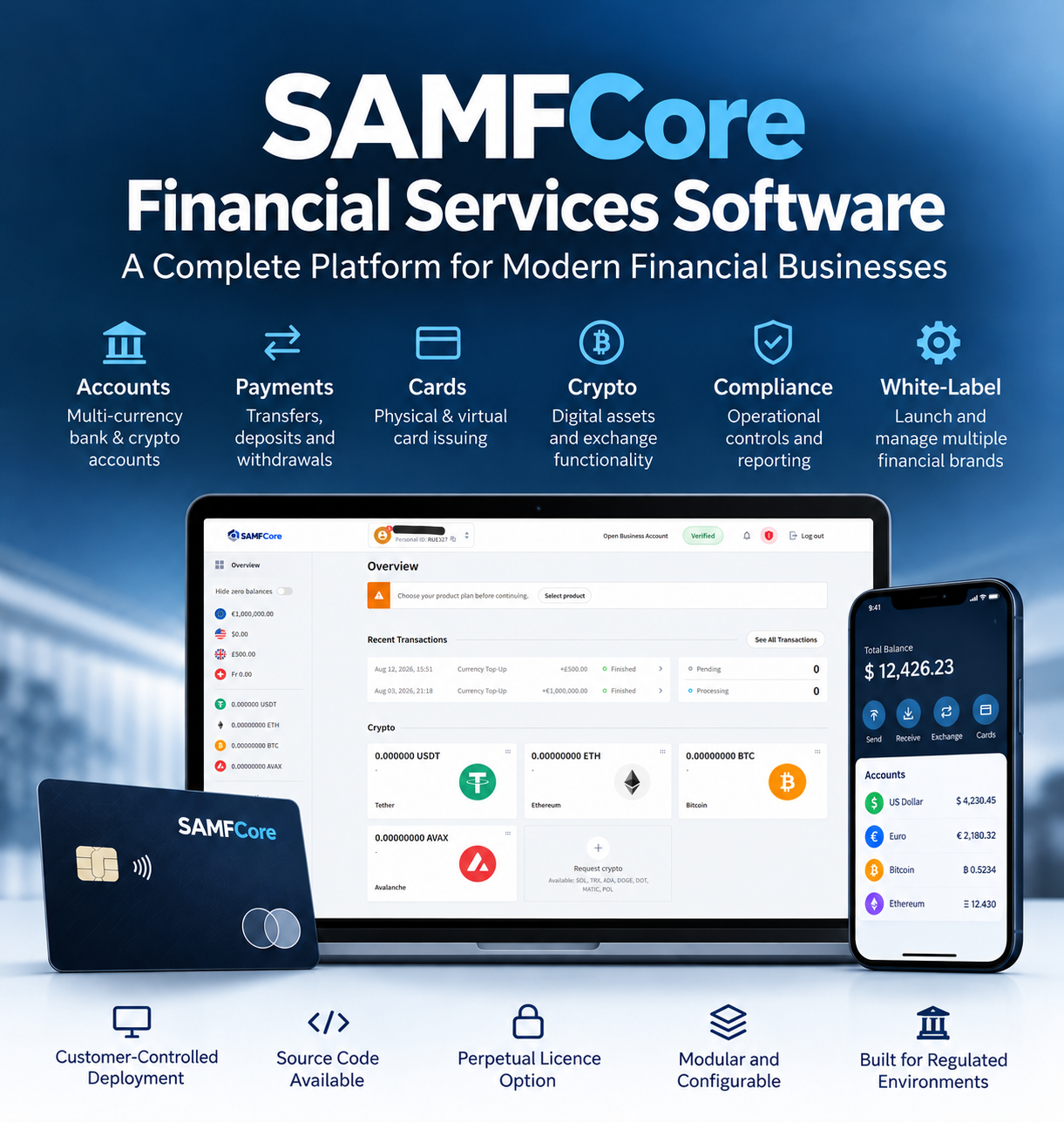
Financial services software must often support far more than one isolated product. A business may need customer onboarding, accounts, payments, cards, digital assets, compliance workflows, reporting, administration and integrations with external providers at the same time.
When those functions are spread across separate systems, the business can end up managing multiple interfaces, integrations, vendors and operational processes. The more useful evaluation question is therefore not only which features appear on a checklist, but whether the technology can support the wider financial operation through a common platform architecture.
SAMFCore is designed around that broader requirement as a financial services softwareand integration environment.
Why Financial Services Software Becomes Fragmented
Financial businesses often build their technology stack gradually. One provider may handle onboarding, another payments, and card functionality may come from a separate system. Digital assets, compliance, reporting and administrative workflows may require additional software.
Each system may work independently. The challenge appears when customer data must remain consistent, transaction activity must be visible to compliance teams, cards must connect to customer accounts, fees must be applied correctly, and reporting needs information from several operational areas.
A broader financial services platform can reduce this fragmentation by providing a common operating environment. Buyers exploring the related concept of a modern banking software platformcan also examine how these functions fit together in day-to-day operations.
Customer Onboarding and Identity Verification
SAMFCore supports registration and onboarding workflows for both personal and business customers.
Personal customers can move through KYC identity-verification workflows. Business customers can complete KYB processes covering company information, ownership structures, ultimate beneficial owners and supporting documents. The relevant verification and screening services are supplied through deployment-specific external providers.
Administrative users can review customer profiles, approve or reject applications, adjust risk levels and apply additional review procedures where necessary. Connecting onboarding to the wider platform helps reduce the separation between customer acquisition, compliance and account operations.
Accounts, IBANs and Balances
SAMFCore supports bank-account and IBAN workflows together with currency accounts, deposits and withdrawals. External banking services and account providers are selected and configured for each deployment.
Customers can access balances and financial activity through a unified environment. For operators, this creates a common customer-account structure that can connect with payments, cards, digital assets and compliance processes.
This matters when comparing banking software or bank software because account functionality should not be assessed in isolation from the rest of the financial operation.
Payments and Transaction Management
SAMFCore includes transaction infrastructure supporting deposits, withdrawals, card activity and exchange transactions. Customers can review transaction histories, while administrators can perform operational reviews and compliance checks where required.
External banks and payment providers remain customer-selected and deployment-specific. SAMFCore acts as the financial software and integration layer while the business retains flexibility over the external providers it uses. For many companies, that provider flexibility is as important as the payment functionality itself.
Card Functionality
A broad financial platform can connect card workflows with customer accounts, transactions, compliance and digital assets. SAMFCore supports physical and virtual card workflows including:
- card ordering;
- card activation;
- PIN and ePIN management;
- freezing and unfreezing;
- card balance top-ups.
The external card programme can involve an issuer, processor, BIN sponsor or other customer-selected providers. SAMFCore does not provide those regulated services itself; its software layer allows card issuing software workflows to operate as part of the wider financial-services environment.
Digital Assets Alongside Fiat
Some businesses need cryptocurrency or digital-asset functionality alongside traditional currencies. SAMFCore supports digital-asset accounts and fiat and crypto exchange workflows within the wider customer platform, including market and limit exchange functionality.
For businesses developing crypto-enabled financial services, a common customer and administrative environment can reduce the need to operate completely separate fiat and crypto banking software stacks. Custody, liquidity, exchange and blockchain services remain dependent on the customer-selected providers and configuration for each deployment.
Compliance as Part of the Financial Platform
Compliance processes interact with nearly every part of a financial business. Customer onboarding affects account access, transaction activity may require AML review, risk levels may change how customers are handled, and documents may need to be requested and reviewed.
SAMFCore supports:
- KYC and KYB workflows;
- customer risk levels;
- document collection;
- administrative profile review;
- AML transaction controls;
- integrations with external screening providers;
- escalated review processes.
This keeps compliance activity connected to the customer and transaction data under review. KYC, KYB, AML and sanctions-screening services themselves remain deployment-specific and are delivered by the relevant external providers.
Back-Office Administration
The customer-facing interface is only one part of a digital banking platform. Operational teams also need tools for managing:
- customer profiles;
- transactions;
- documents;
- compliance activity;
- fees;
- permissions;
- reporting;
- audit records;
- platform configuration.
SAMFCore includes a dedicated administrative environment with role-based access controls and operational workflows. Reporting and analytical functionality provide additional visibility into platform activity. Buyers comparing fintech software should review this back-office environment as closely as the customer interface.
White-Label Financial Services
SAMFCore includes white-label tenant functionality that can support multiple branded customer experiences through the broader platform architecture. This may be relevant to fintech groups, licensed financial institutions, businesses operating multiple propositions, and companies developing products for partners or market segments.
Legal and regulatory responsibilities still depend on the entities and providers involved. As one capability within the wider platform, the white label fintech platform functionality can reduce the need to build and maintain a separate software environment for every brand.
External Providers Should Remain Flexible
A modern financial-services platform does not necessarily replace every external provider. A deployment may still require:
- banks and payment providers;
- card issuers, processors and BIN sponsors;
- KYC, KYB, AML and sanctions-screening providers;
- digital-asset custodians;
- liquidity providers and exchanges;
- blockchain infrastructure.
SAMFCore is designed so these external services can be selected according to each deployment. The platform remains the operating and integration layer while the customer retains flexibility over its external financial-services ecosystem.
Why Licensing Matters
A financial software licensing model can affect long-term economics and technology control. SAMFCore offers annual and perpetual licence models. Under the applicable perpetual model, the licensed business has continuing rights to operate its deployment under the licence terms rather than needing indefinite recurring SAMFCore software licensing simply to retain access.
A full-source code option is also available with the applicable perpetual licence. For qualifying deployments, source-code access can allow the customer to inspect, modify, develop and maintain its licensed deployment using internal or appointed third-party developers.
This can matter to businesses that view software ownership and controlas part of their long-term infrastructure strategy rather than treating the platform as a temporary subscription. Finance teams can examine the related cost categories in the five-year TCO executive briefing.
Customer-Controlled Deployment
SAMFCore can support customer-controlled deployment models. This can give a licensed business more direct control over hosting, infrastructure, access management, development processes, operational security, data location and future technical changes.
Customer-controlled deployment does not automatically make a platform more secure. It gives the customer greater direct control and corresponding responsibility for how the infrastructure is operated. For organizations with suitable technical resources, that balance of control and responsibility can be material when evaluating financial software.
What Buyers Should Ask Before Selecting Financial Services Software
A feature checklist is not enough. Businesses should ask:
- Does the platform support personal and business onboarding?
- Are KYC and KYB workflows included?
- Can fiat accounts and digital assets operate together?
- How are bank-account and IBAN workflows handled?
- Can customers review transaction history?
- Are physical and virtual card workflows supported?
- How are AML and compliance reviews handled?
- What administrative controls are available?
- Can multiple brands operate on the platform?
- Can the business choose external providers?
- What reporting and audit functionality exists?
- Is customer-controlled deployment possible?
- Are perpetual licensing and source-code access available?
- Can internal or third-party developers maintain the deployment?
- Can the technology expand as the business grows?
These questions reveal whether a banking platform is merely a collection of visible features or suitable long-term infrastructure. Buyers comparing market approaches can also review the focused Mambu comparisonand SDK.finance comparison without assuming that one model suits every organization.
Financial Services Software as Business Infrastructure
For financial-services companies, the software platform can become one of the most important parts of operational infrastructure. Accounts, payments, cards, digital assets, compliance and administration need to work together, and external providers need to connect reliably.
The business also needs to understand who controls the software and infrastructure, and how the licensing model affects long-term vendor dependence. SAMFCore is designed as a broad financial services software platform for organizations that want to consolidate these functions while retaining flexibility over providers, deployment and future development.
For businesses comparing financial services software, banking software, digital banking platforms and fintech software, these architectural and commercial considerations can be as important as the visible customer features.
Explore SAMFCore and request a sandbox demonstration of the customer and administrative platforms. Request a sandbox demonstration.