
Banking & Financial Services Software
Banking Software for Modern Financial Services: What a Complete Platform Should Provide
SAMFCore brings accounts, payments, cards, digital assets, compliance and operational administration into one financial-services software platform. This guide explains what businesses should consider when evaluating modern banking software.
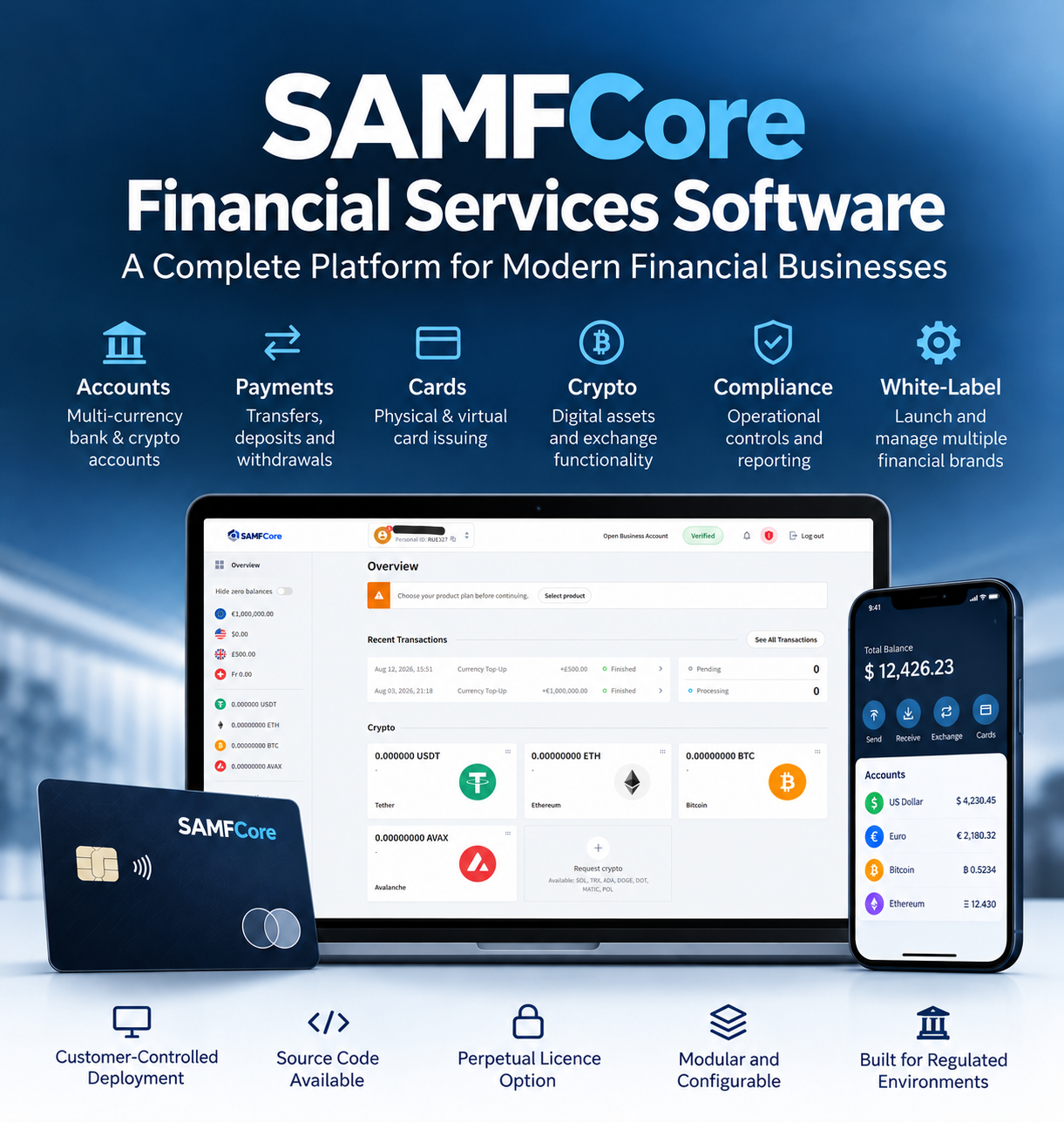
Financial-services businesses rarely operate with a single technology requirement. A company may need customer onboarding, fiat accounts, payments, cards, digital assets, compliance processes, reporting, administrative controls and integrations with external providers at the same time.
That is why modern banking software increasingly needs to do more than manage one isolated account or payment function.
For fintech companies and licensed financial-services businesses, the real question is whether the technology can support the wider operation without forcing the business to assemble and maintain a fragmented collection of unrelated systems.
SAMFCore is designed around that broader requirement.
What Modern Banking Software Needs to Manage
A modern financial-services platform may need to coordinate multiple parts of the customer and operational lifecycle, including:
- personal and business onboarding;
- KYC and KYB processes;
- fiat accounts and currencies;
- bank-account and IBAN workflows;
- deposits and withdrawals;
- payments and transaction histories;
- physical and virtual cards;
- digital assets;
- fiat-to-crypto and crypto-to-fiat functionality;
- compliance monitoring;
- fee management;
- customer communications;
- administrative permissions;
- reporting;
- audit records.
When these capabilities operate through disconnected systems, the business must manage multiple interfaces, integrations, vendors and operational processes. A broader financial services software platform can reduce that fragmentation by providing a common operating environment.
Accounts and Financial Activity in One Environment
SAMFCore supports customer account functionality across currencies, bank accounts, cards and digital assets.
Customers can access balances and financial activity within a unified environment rather than requiring a separate application for every asset or service.
Bank-account functionality supports account and IBAN workflows together with currency deposits and withdrawals. Transaction histories can cover deposits, withdrawals, card activity and exchange transactions.
This gives financial-services businesses a central operating environment while still allowing external banking and payment providers to be configured according to the needs of each deployment.
Card Issuing and Card Management
Cards are an important part of many digital-banking and fintech products.
SAMFCore supports physical and virtual card workflows, including ordering, activation, PIN management, freezing and unfreezing, and balance top-ups.
The external card infrastructure may involve card issuers, processors, BIN sponsors or other providers selected for the deployment. SAMFCore acts as the software and integration layer through which the relevant card functionality can be incorporated into the wider customer experience.
This allows card issuing software workflows to operate alongside customer accounts, payments, compliance processes and digital assets rather than as a completely separate technology stack.
Digital Assets Alongside Fiat
Modern financial-services companies may need to support both traditional currencies and digital assets.
SAMFCore provides digital-asset account functionality and administrative controls for supported cryptocurrencies.
The platform also supports exchange workflows between currency and cryptocurrency accounts, including market and limit exchange functionality.
This enables businesses to structure fiat and digital-asset services inside a common customer and administrative environment rather than maintaining completely separate systems. For companies developing crypto-enabled financial products, this provides digital asset infrastructure for fiat-to-crypto and crypto-to-fiat services.
KYC, KYB and Compliance Workflows
Customer onboarding and compliance are central parts of a financial-services platform.
SAMFCore includes onboarding workflows for both individuals and businesses.
Personal customers can move through KYC identity-verification processes. Business customers can complete KYB workflows covering company information, ownership structure, ultimate beneficial owners and supporting documents.
Administrative users can review customer profiles, adjust risk levels, request documents and apply additional review procedures where required. The platform also supports AML transaction controls, historical transaction review and integrations with third-party screening providers.
Bringing these workflows into the same operating environment helps connect customer activity with the compliance processes used to monitor it.
Back-Office and Administrative Control
The customer-facing interface is only one part of financial-services technology.
Operational teams need tools to manage customers, transactions, compliance cases, documents, fees and administrative permissions.
SAMFCore provides a dedicated administrative environment with role-based access controls and operational workflows.
Businesses can define administrator access based on responsibilities while audit records provide visibility over activity across the platform. Reporting functionality, account-balance snapshots and analytical tools provide further operational oversight.
External Providers Remain Deployment-Specific
SAMFCore provides software infrastructure and an integration framework.
That does not mean every external financial service is automatically provided by SAMFCore itself.
A deployment may require selected external providers such as:
- banks;
- payment providers;
- card issuers;
- card processors;
- BIN sponsors;
- KYC and KYB providers;
- AML and sanctions-screening providers;
- digital-asset custody providers;
- liquidity providers;
- exchanges;
- blockchain infrastructure.
These providers can be selected and integrated according to the commercial, technical and regulatory requirements of each deployment. This gives the customer flexibility over its external provider ecosystem rather than requiring every SAMFCore implementation to use an identical set of counterparties.
White-Label Financial Services
Financial groups and fintech businesses may want to operate more than one customer-facing brand.
SAMFCore includes white-label tenant functionality that can support multiple branded experiences through the broader platform architecture. The legal and regulatory structure still depends on which entity provides the underlying financial services and how the deployment is structured.
From a technology perspective, however, white-label functionality can allow multiple brands to use a common underlying white label fintech platform instead of requiring a separate system for every brand.
Annual, Perpetual and Source-Code Licensing
The commercial structure of banking software can materially affect the long-term economics and control of a financial-services business.
SAMFCore is available through annual and perpetual licensing models.
A perpetual licence gives the licensed business continuing rights to operate the applicable SAMFCore deployment under the licence terms rather than requiring indefinite recurring SAMFCore software licensing merely to retain access.
SAMFCore also offers an optional full-source-code model with the applicable perpetual licence.
For qualifying deployments, source-code access can allow the customer to inspect, modify, develop and maintain its own licensed deployment using internal developers or appointed third-party developers. This can be particularly relevant to companies that view their financial software as long-term infrastructure rather than a temporary software subscription.
Customer-Controlled Infrastructure
Deployment architecture is another important consideration when selecting banking software.
A business may have specific requirements relating to hosting, infrastructure control, data residency, access management, monitoring or internal development processes.
SAMFCore can support customer-controlled deployment models, allowing the licensed business to retain greater control over its operating environment.
Customer-controlled deployment does not automatically make a system more secure. It gives the customer greater direct control and responsibility for how infrastructure, access, monitoring, patching and operational security are managed.
For organizations with the appropriate technical capabilities, this can be an important distinction from vendor-controlled software environments.
What to Ask When Evaluating Banking Software
Financial institutions and fintech companies should evaluate more than a feature checklist when selecting a technology platform.
Important questions include:
- Which functions are available today?
- Which external providers can be integrated?
- Can the business use its preferred infrastructure?
- Does the platform support fiat and digital assets?
- Can multiple brands be operated?
- How are customers and administrators managed?
- What are the licensing restrictions?
- Are there software fees based on transaction volume?
- Is a perpetual licence available?
- Is source-code access available?
- Can the company use its own developers?
- Can providers be changed later?
- Can the system support future geographic or product expansion?
For a financial-services business, these questions can affect operating costs, independence, scalability and long-term technology control. Buyers comparing commercial models may also review how SAMFCore differs from Mambu and SDK.finance.
More Than a Single-Function Banking Platform
SAMFCore brings customer accounts, payments, cards, digital assets, compliance workflows and operational administration into one financial-services software environment.
It is designed for businesses that need more than a single-function fintech software product and want greater flexibility over infrastructure, integrations, licensing and development.
Potential users can include licensed financial institutions, fintech companies, payment businesses, digital-asset businesses and companies developing white-label financial products.
When evaluating a banking platform, the decision therefore extends beyond what appears on the customer dashboard. The underlying financial infrastructure platform, integration model, licensing structure and degree of technology control can be equally important.
See how SAMFCore can support your financial-services business. Request a sandbox demonstration.