
Digital Banking & Neobanks
Digital Banking Platform: What Financial Businesses Need Beyond the Customer App
A polished mobile app is what customers see, but the digital banking platform behind it decides whether a financial business can onboard, transact, comply and scale. This guide sets out the capabilities to look for and the questions to ask before choosing one.
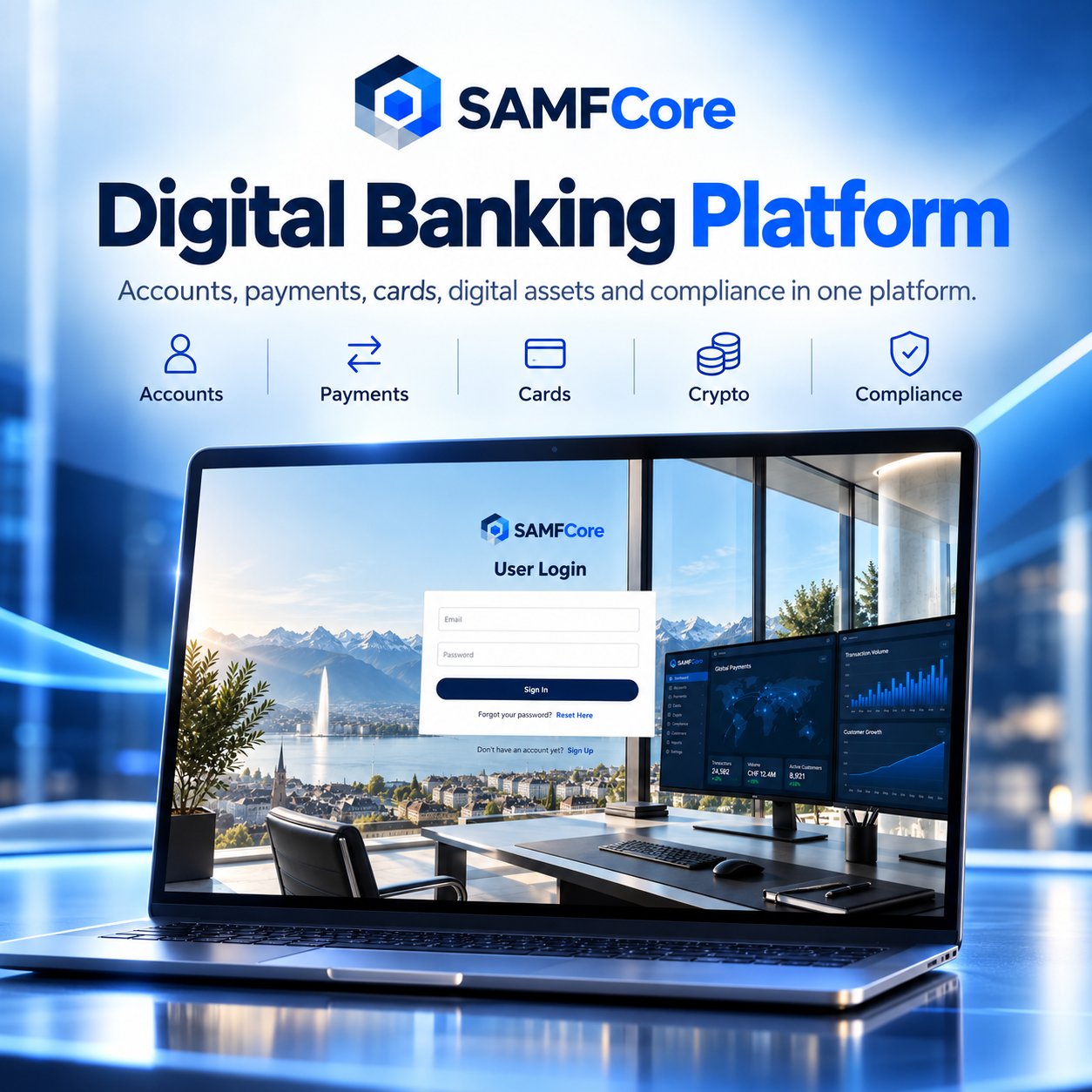
When people picture digital banking, they usually picture an app: a clean dashboard, a balance, a card and a payment button. For the business operating that service, the app is only the visible surface. Behind it, a digital banking platform has to register and verify customers, hold account records, process and record transactions, run card workflows, support compliance reviews, apply fees and give staff the tools to administer everything safely.
Choosing technology on the strength of the front end alone is one of the most common mistakes new fintech businesses make. This guide explains what sits beneath the interface, which capabilities matter, and how to evaluate digital banking software as long-term infrastructure rather than as a design project.
What Is a Digital Banking Platform?
In practical software terms, a digital banking platform is the operating environment that connects the customer experience to the business processes behind it. A serious platform links customer onboarding, account functionality, payments, cards, compliance, administration and integrations with external providers, so that each function works from shared customer and transaction data.
It is important to separate software from regulated activity. A digital banking platform is technology. It does not make its operator a bank, and the software vendor is not a bank either. SAMFCore is financial services software: regulated services such as account provision, card issuing, custody or screening are delivered by licensed operators and customer-selected providers, with SAMFCore acting as the software and orchestration layer that connects them.
Why the Customer App Is Only the Beginning
The customer interface shows balances and lets users act. The operational platform decides what those actions actually do. When a customer opens an account, someone must review their identity documents. When a payment arrives, it must be recorded, attributed and, where required, screened. When a card is frozen, the account, the card provider and the support team all need the same view.
That only works when customer data, transactions, compliance reviews, staff permissions, provider integrations and reporting operate together. If each lives in a separate tool, the business spends its time reconciling systems instead of serving customers. The value of digital banking software lies largely in how well it joins these pieces up.
Personal and Business Customer Onboarding
Onboarding is where the customer relationship and the compliance obligation begin at the same time. SAMFCore supports registration for both personal and business customers. Personal customers move through KYC identity workflows. Business customers complete KYB processes that capture company information, ownership structures, ultimate beneficial owner (UBO) details and supporting documents.
Administrative users can then review applications, request additional information, approve or reject customers and set risk levels. Keeping onboarding inside the same platform as accounts and transactions means the information gathered at registration stays available to the compliance and operations teams later.
Bank Accounts, IBANs and Customer Balances
Account functionality is the core of most digital banking propositions. SAMFCore supports bank-account and IBAN workflows, multiple currencies, deposits, withdrawals and customer balance visibility. Customers see their balances and activity in one place; operators get a consistent account structure that connects to payments, cards, digital assets and compliance.
The underlying accounts and IBANs are provided through external banking partners chosen for each deployment. The platform manages the workflows and records around them.
Payments and Transaction Management
A digital banking platform must give a complete, reliable picture of money movement. SAMFCore records transaction history across deposits, withdrawals, card transactions and exchange activity, and gives administrators tools to review transactions where operational or compliance checks are needed.
The external banks and payment providers that actually move funds are deployment-specific and selected by the operator. That separation lets a business change or add providers without replacing its core banking software.
Cards Within a Digital Banking Platform
Cards are often the most visible product a digital banking business offers. SAMFCore supports physical and virtual card workflows, including card activation, PIN and ePIN handling, freeze and unfreeze controls and card top-ups, all linked to the customer's account.
Card issuing itself, processing, BIN sponsorship and related infrastructure are provided by external card issuers and processors that depend on the deployment. SAMFCore is designed to integrate with those providers rather than replace them. The card issuing platform page explains these boundaries in more detail.
Digital Assets and Crypto-Enabled Banking Software
A growing number of businesses want to offer digital assets alongside traditional currency accounts. SAMFCore supports digital-asset balances next to fiat accounts, together with currency and crypto exchange workflows, so customers can manage both from one environment and operators can apply the same onboarding, compliance and reporting processes to each.
Custody, liquidity and exchange execution are provided by customer-selected external providers. Read more about crypto and digital asset infrastructure in SAMFCore.
Compliance and Risk Controls
Compliance cannot be bolted on after launch. SAMFCore provides workflow tools covering KYC and KYB review, customer risk levels, document review and AML transaction controls, and connects these to provider integrations for verification and screening.
SAMFCore does not itself supply identity-verification databases or sanctions and PEP lists. Those checks are performed by third-party providers integrated into the workflow. The platform's role is to bring the results into one place where compliance staff can review, decide and keep a record.
Back-Office Banking Software
Much of what determines whether a digital banking business runs well happens in the back office. Customer administration, role-based staff permissions, reporting, audit records, fee configuration and operational controls let a business work efficiently while showing auditors and regulators how decisions were made.
When evaluating banking software, spend as much time in the administration panel as in the customer app. That is where your team will work every day.
White-Label Digital Banking
SAMFCore includes white-label tenant functionality, which allows a deployment to present services under the operator's own brand and, where required, support more than one brand. This is one capability within a broader platform, not its defining purpose.
It also helps to distinguish technology from legal structure. White-label software can support the customer experience of a brand, but who holds the relevant licences, who contracts with providers and who carries regulatory responsibility are questions for the deployment's legal and regulatory structure, not the software.
External Financial-Service Providers
No single platform supplies every regulated service a digital banking business needs. Deployments typically involve banks, payment providers, card issuers and processors, KYC and KYB services, AML screening providers, custodians, liquidity providers and exchanges.
SAMFCore is designed to integrate with customer-selected providers through deployment-specific integrations. That provider flexibility matters: it lets a business choose partners suited to its markets, negotiate its own commercial terms and change providers over time without rebuilding its operation. Our API and integrations overview describes the integration areas.
Annual vs Perpetual Digital Banking Software
The commercial model shapes long-term cost and control as much as the feature set. SAMFCore is available under annual and perpetual licensing. A perpetual licence provides continuing rights to use the licensed software for the licensee's own operations, without volume-based software fees, and full source code is available as an option with the applicable perpetual licence.
For a deeper look at how ownership compares with recurring subscription models, see perpetual licensing vs SaaS. Businesses comparing specific vendors can also review Mambu vs SAMFCore and SDK.finance vs SAMFCore.
Customer-Controlled Deployment
Customer-controlled deployment means the operator decides where and how the platform runs: in its own data centre, in a private cloud or with a hosting partner it selects. It governs infrastructure, access, change management and the pace of development.
This is not automatically more secure than a well-run managed service. Security depends on how the environment is designed and operated. What customer control does provide is choice: over hosting, over development priorities and over dependence on any single technology vendor.
How to Evaluate a Digital Banking Platform
Use this checklist when comparing digital banking software:
- Onboarding: does it handle both personal KYC and business KYB, including UBOs and documents?
- Account functionality: are multi-currency accounts, IBAN workflows and balance views supported?
- Payments: is transaction history complete and reviewable by staff?
- Cards: are physical and virtual card workflows linked to accounts, with your choice of issuer?
- Fiat and digital assets: can both be managed in one environment if your model needs it?
- Compliance: are risk levels, document review and AML controls built into the workflow?
- Back-office functionality: are permissions, fees and operational controls configurable?
- Reporting: can you produce the operational and audit information you need?
- White-label capability: can you operate under your own brand, or several brands?
- External provider flexibility: can you select and change banks, card providers and screening services?
- Deployment: can you choose where the platform runs?
- Perpetual licensing: is ownership available, or only a recurring subscription?
- Source-code availability: can you obtain the source code if you need it?
- Internal and third-party development: can your own team or contractors extend the platform?
- Scalability: will costs and architecture still work as customer numbers grow?
Digital Banking as Long-Term Infrastructure
A customer app can be redesigned in months. The digital banking platform beneath it tends to stay in place for years. Businesses should therefore evaluate the underlying architecture, integration model, deployment options and commercial structure, not only the visual interface.
For a broader view of the same topic, see our guides to modern banking software and financial services software platforms.
Explore SAMFCore and request a sandbox demonstration of the customer and administrative platforms. Request a sandbox demonstration.